Tell your agent what you’re building, who it’s for, which chain you’re on, and what you need to decide. Ask it to link its sources. The more specific the question, the more useful the answer. Sign in and it knows your own projects and team when your question calls for that context.

Check an idea

Find out who has tried it at a Colosseum hackathon, what they submitted, and what they left unproven.
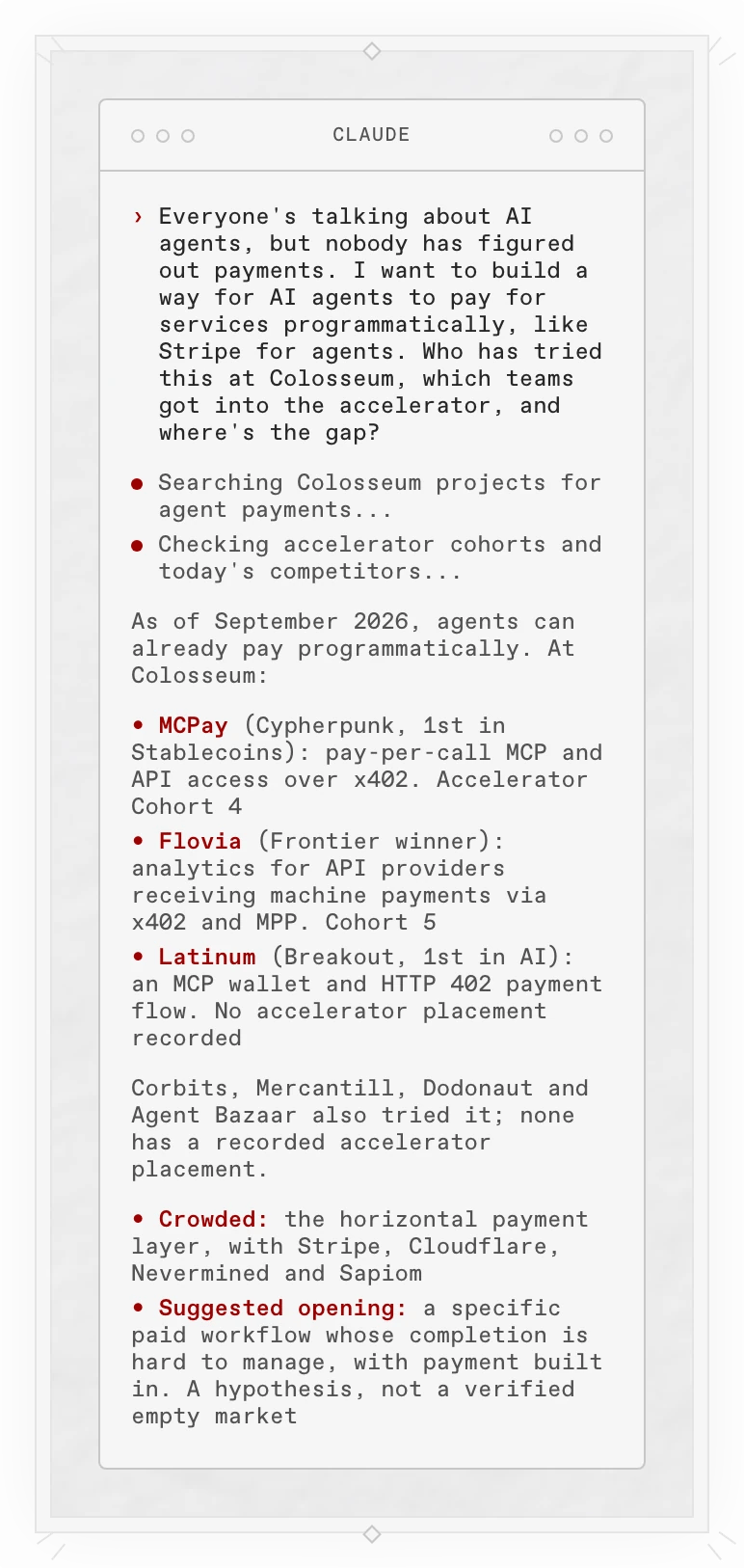
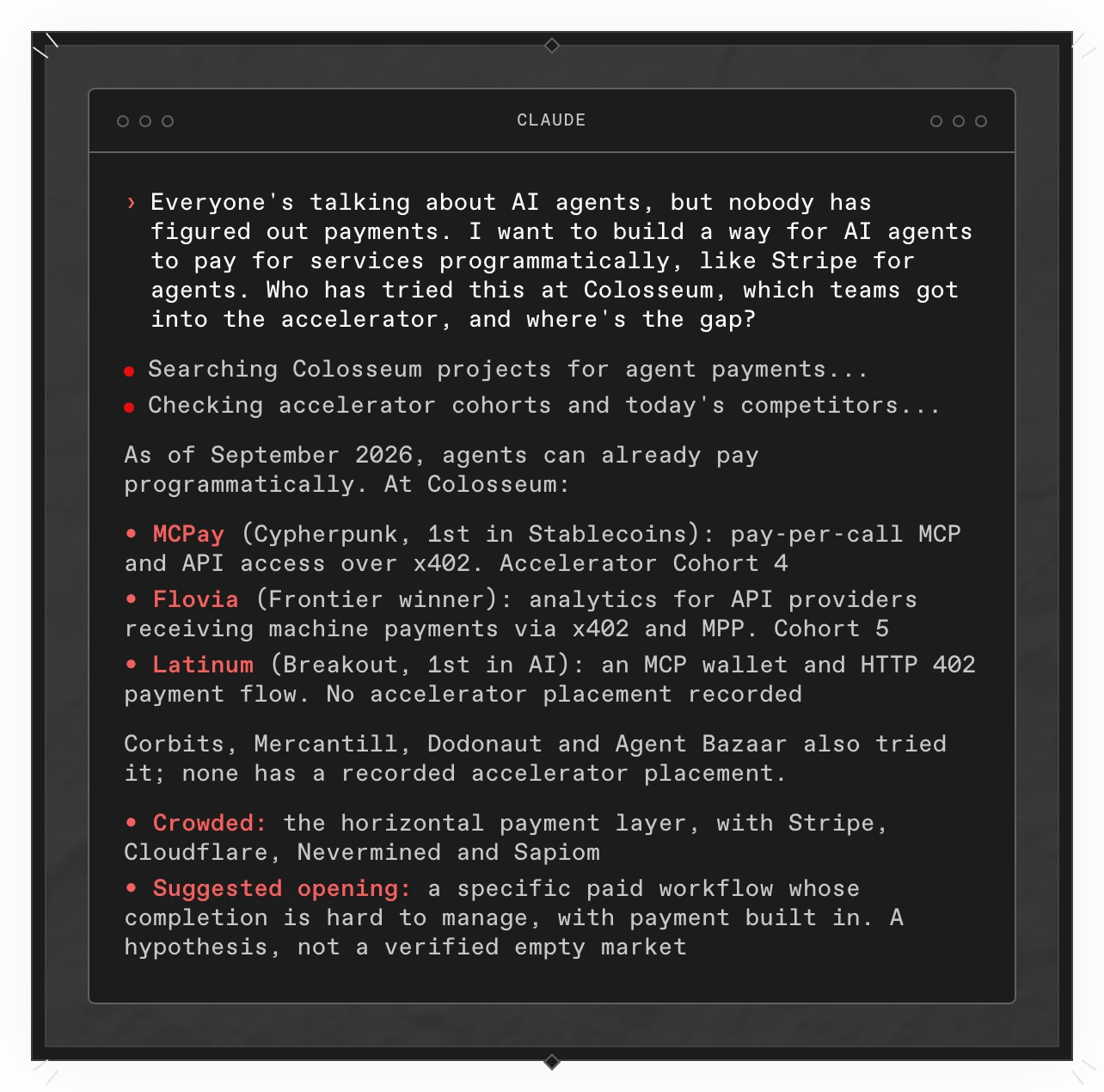
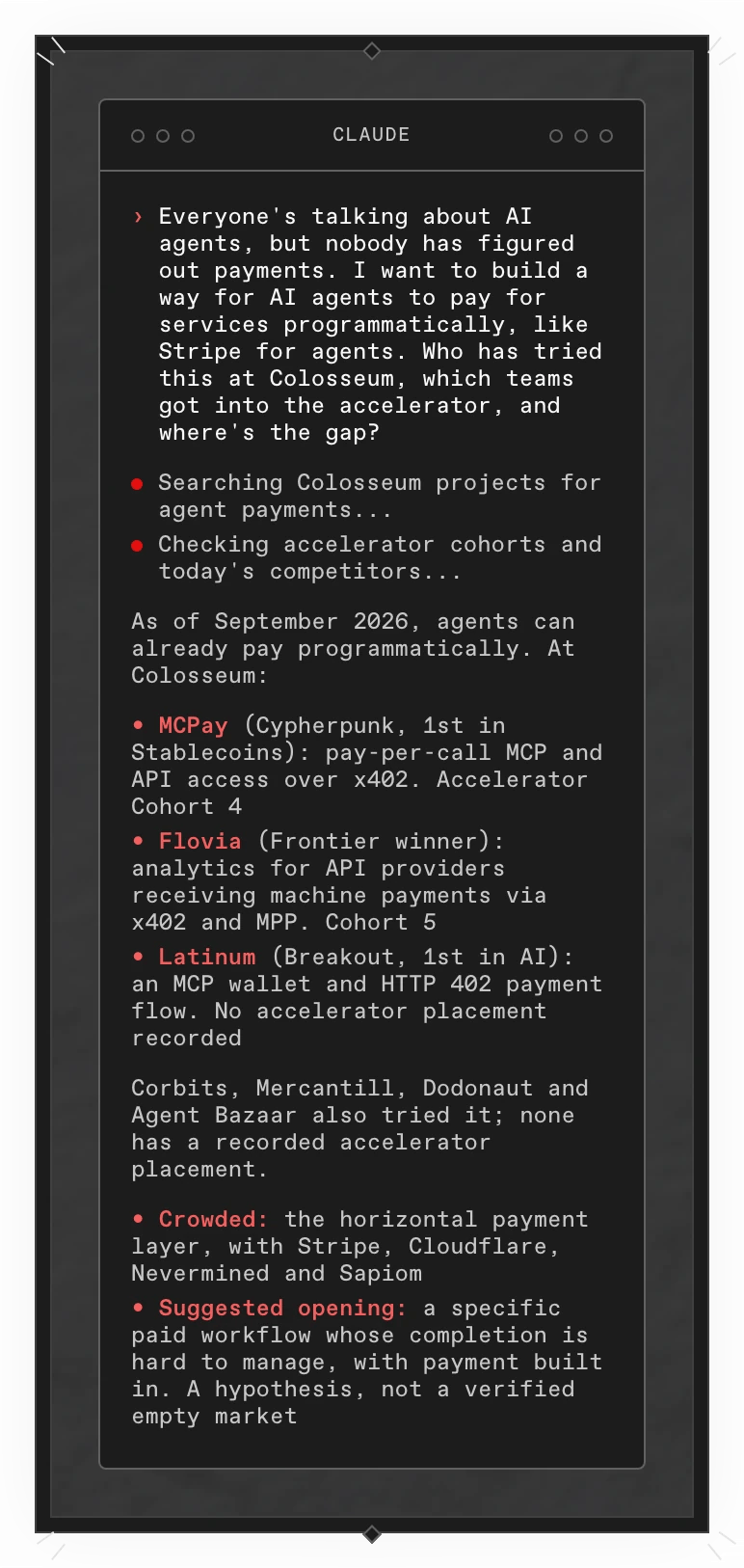
“Everyone’s talking about AI agents, but nobody has figured out payments. I want to build a way for AI agents to pay for services programmatically, like Stripe for agents. Who has tried this at Colosseum, which teams got into the accelerator, and where’s the gap?”
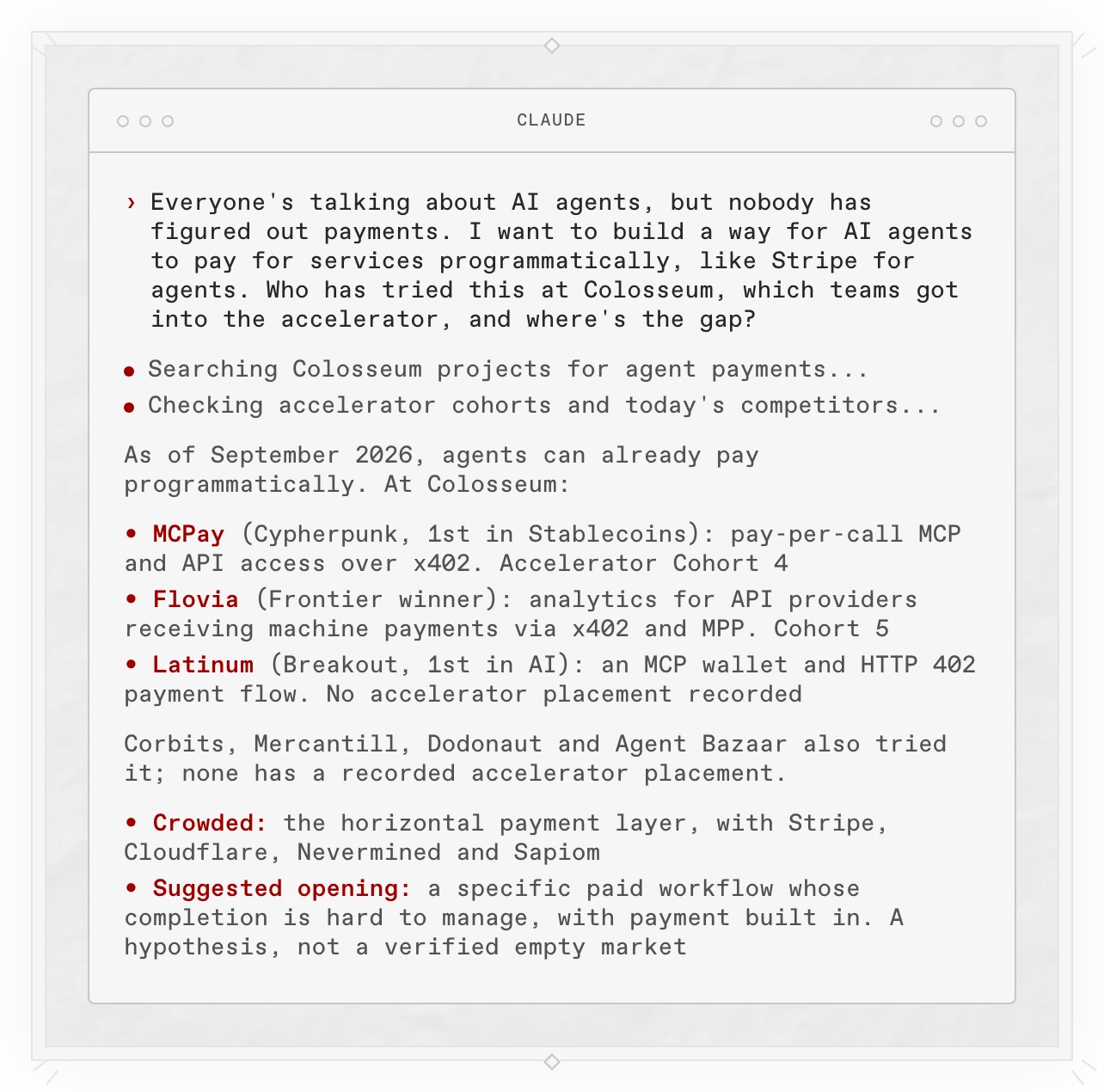
A Copilot answer in a terminal: agents can already pay programmatically. MCPay (accelerator Cohort 4) and Flovia (Cohort 5) got into the accelerator, Latinum and others did not, the horizontal payment layer is crowded, and a specific paid workflow is suggested as a hypothesis to test. A Copilot answer in a terminal: agents can already pay programmatically. MCPay (accelerator Cohort 4) and Flovia (Cohort 5) got into the accelerator, Latinum and others did not, the horizontal payment layer is crowded, and a specific paid workflow is suggested as a hypothesis to test. A Copilot answer in a terminal: agents can already pay programmatically. MCPay (accelerator Cohort 4) and Flovia (Cohort 5) got into the accelerator, Latinum and others did not, the horizontal payment layer is crowded, and a specific paid workflow is suggested as a hypothesis to test. A Copilot answer in a terminal: agents can already pay programmatically. MCPay (accelerator Cohort 4) and Flovia (Cohort 5) got into the accelerator, Latinum and others did not, the horizontal payment layer is crowded, and a specific paid workflow is suggested as a hypothesis to test.

Find tools for your chain

Get a shortlist from Colosseum’s resources hub, which lists tools for each chain in the current hackathon. Copilot can also show which of those tools past teams used.
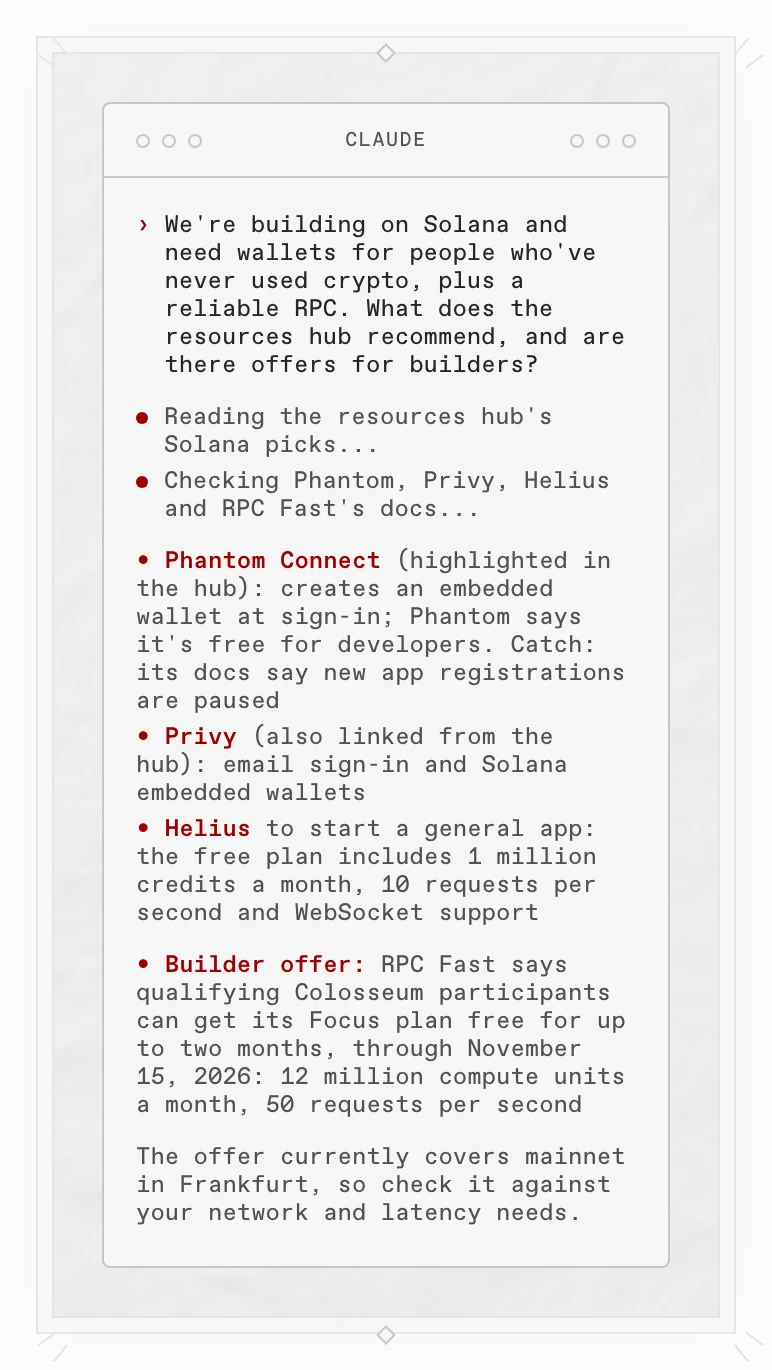
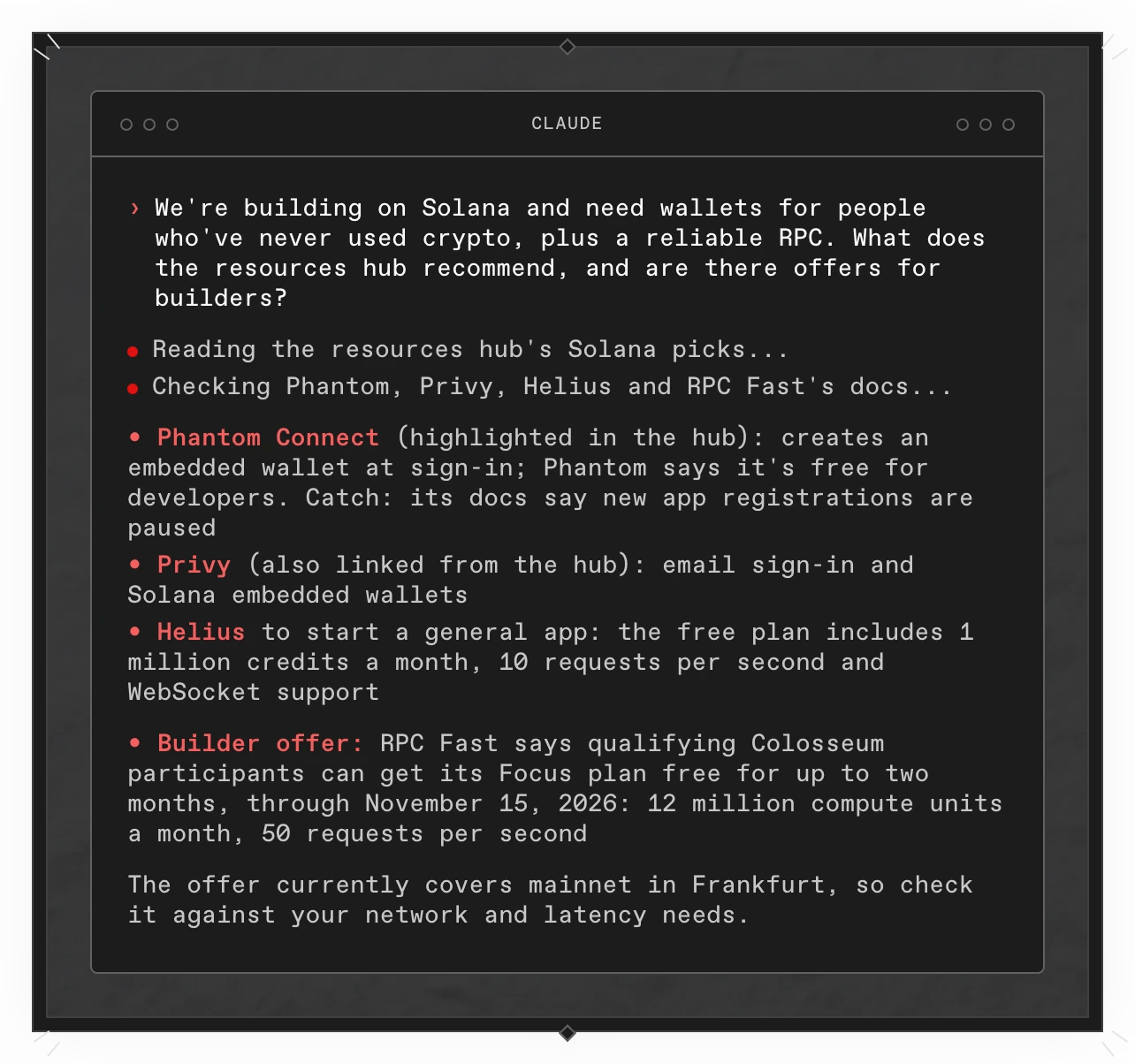
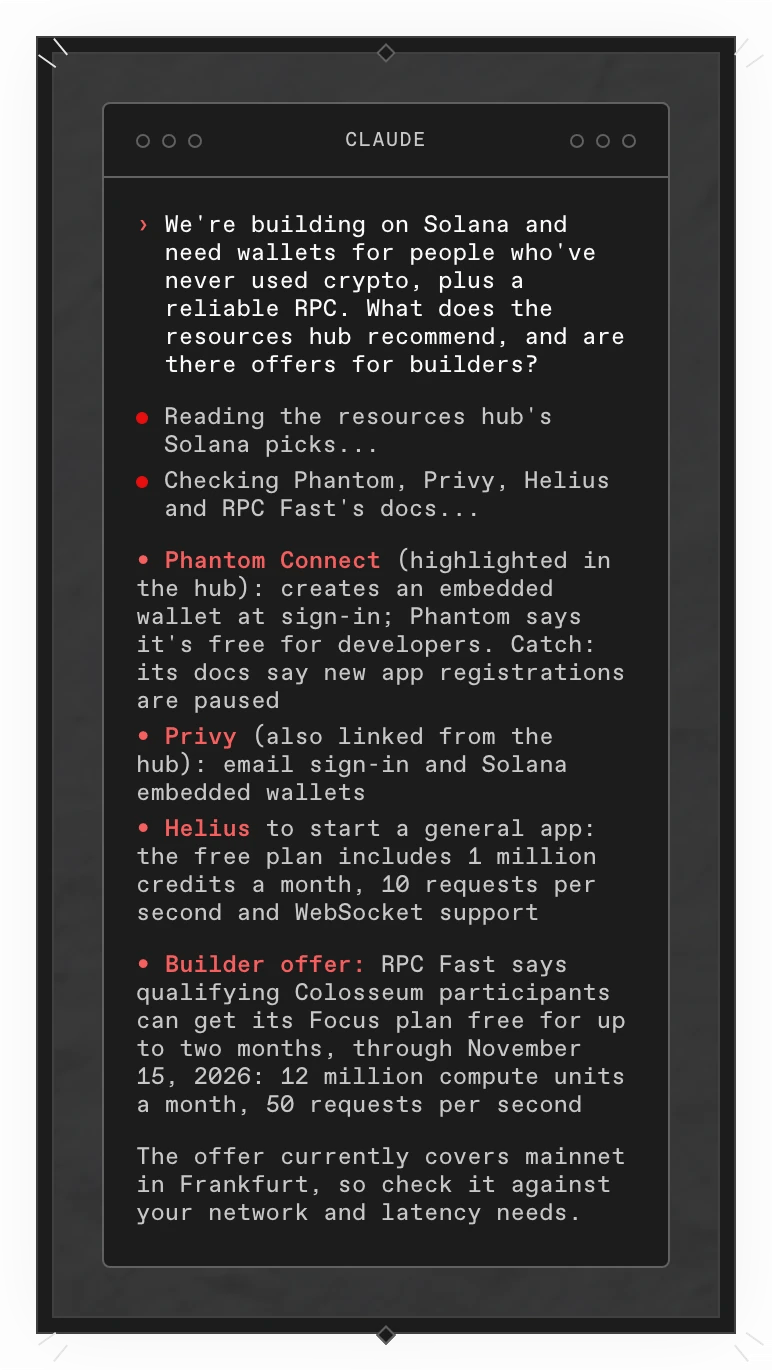
“We’re building on Solana and need wallets for people who’ve never used crypto, plus a reliable RPC. What does the resources hub recommend, and are there offers for builders?”
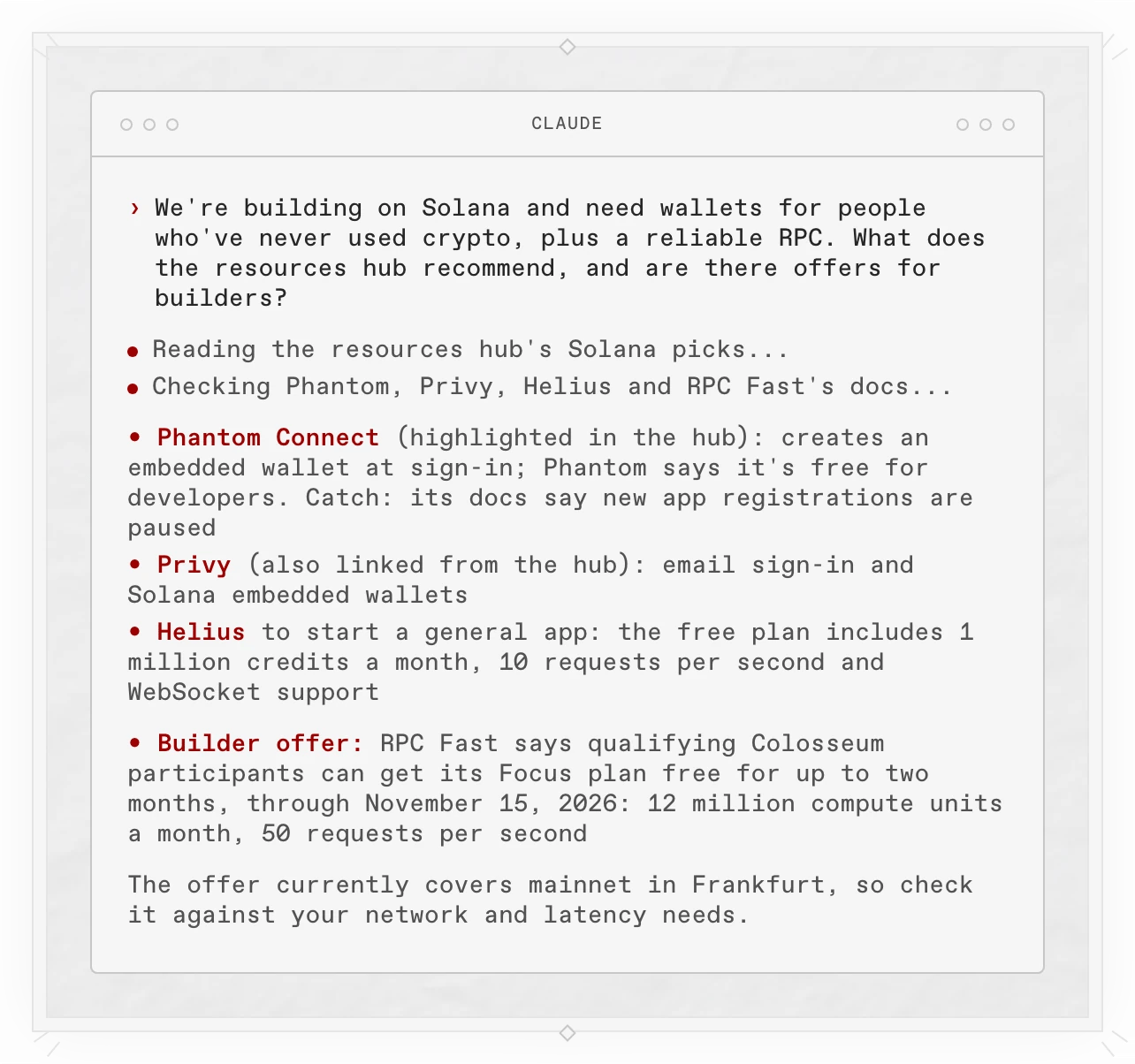
A Copilot answer in a terminal: the resources hub highlights Phantom Connect, whose docs say new app registrations are paused, and also links Privy. Helius's free plan suits a general app, and RPC Fast offers qualifying Colosseum participants its Focus plan free for up to two months, through November 15, 2026. A Copilot answer in a terminal: the resources hub highlights Phantom Connect, whose docs say new app registrations are paused, and also links Privy. Helius's free plan suits a general app, and RPC Fast offers qualifying Colosseum participants its Focus plan free for up to two months, through November 15, 2026. A Copilot answer in a terminal: the resources hub highlights Phantom Connect, whose docs say new app registrations are paused, and also links Privy. Helius's free plan suits a general app, and RPC Fast offers qualifying Colosseum participants its Focus plan free for up to two months, through November 15, 2026. A Copilot answer in a terminal: the resources hub highlights Phantom Connect, whose docs say new app registrations are paused, and also links Privy. Helius's free plan suits a general app, and RPC Fast offers qualifying Colosseum participants its Focus plan free for up to two months, through November 15, 2026.

Get answers about Colosseum programs

Ask about hackathon rules, deadlines and judging, the accelerator, Eternal or STAMP. Copilot answers from Colosseum’s official FAQs and links the program page. For a deadline or an eligibility question, open that page to confirm.
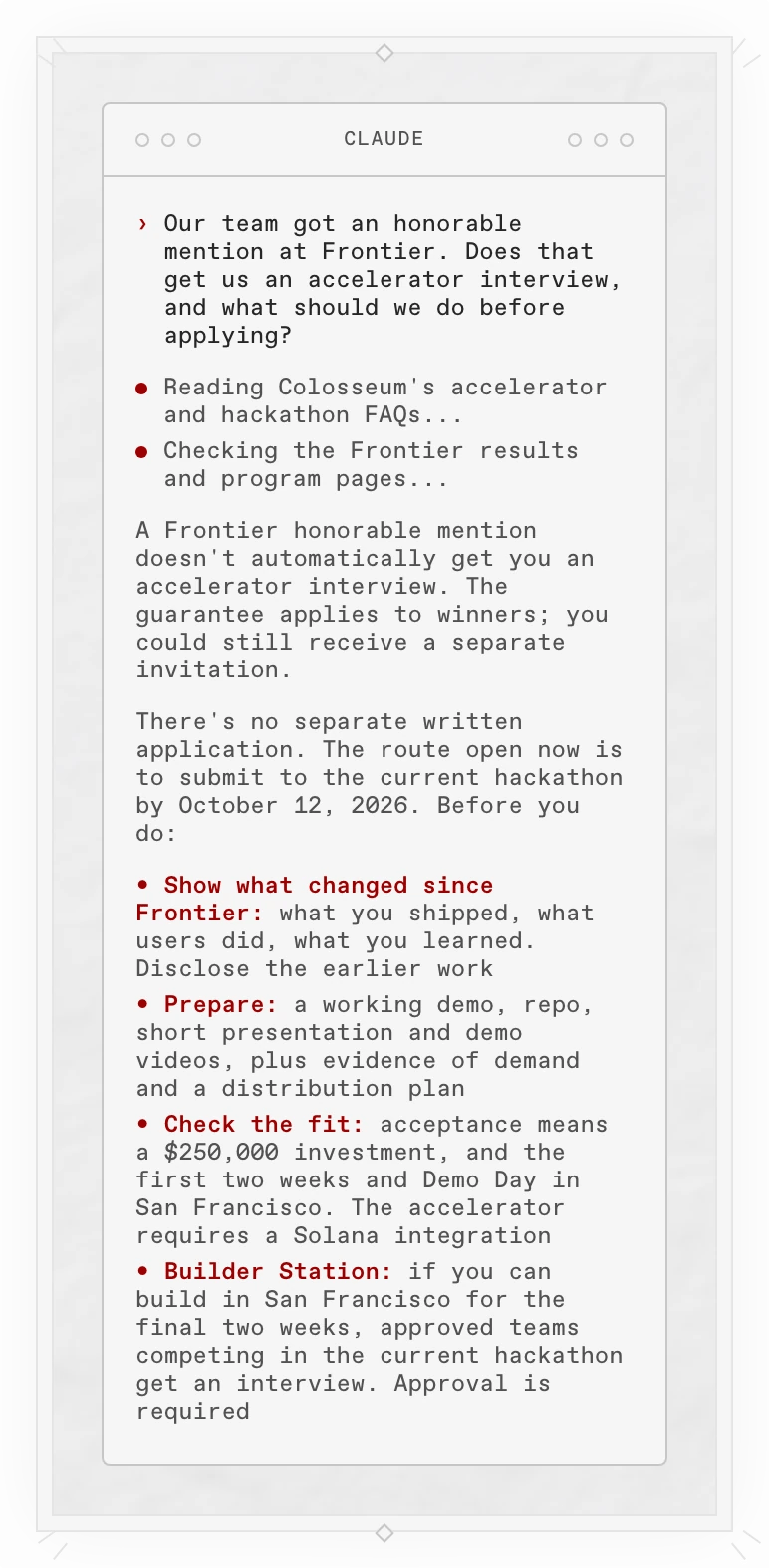
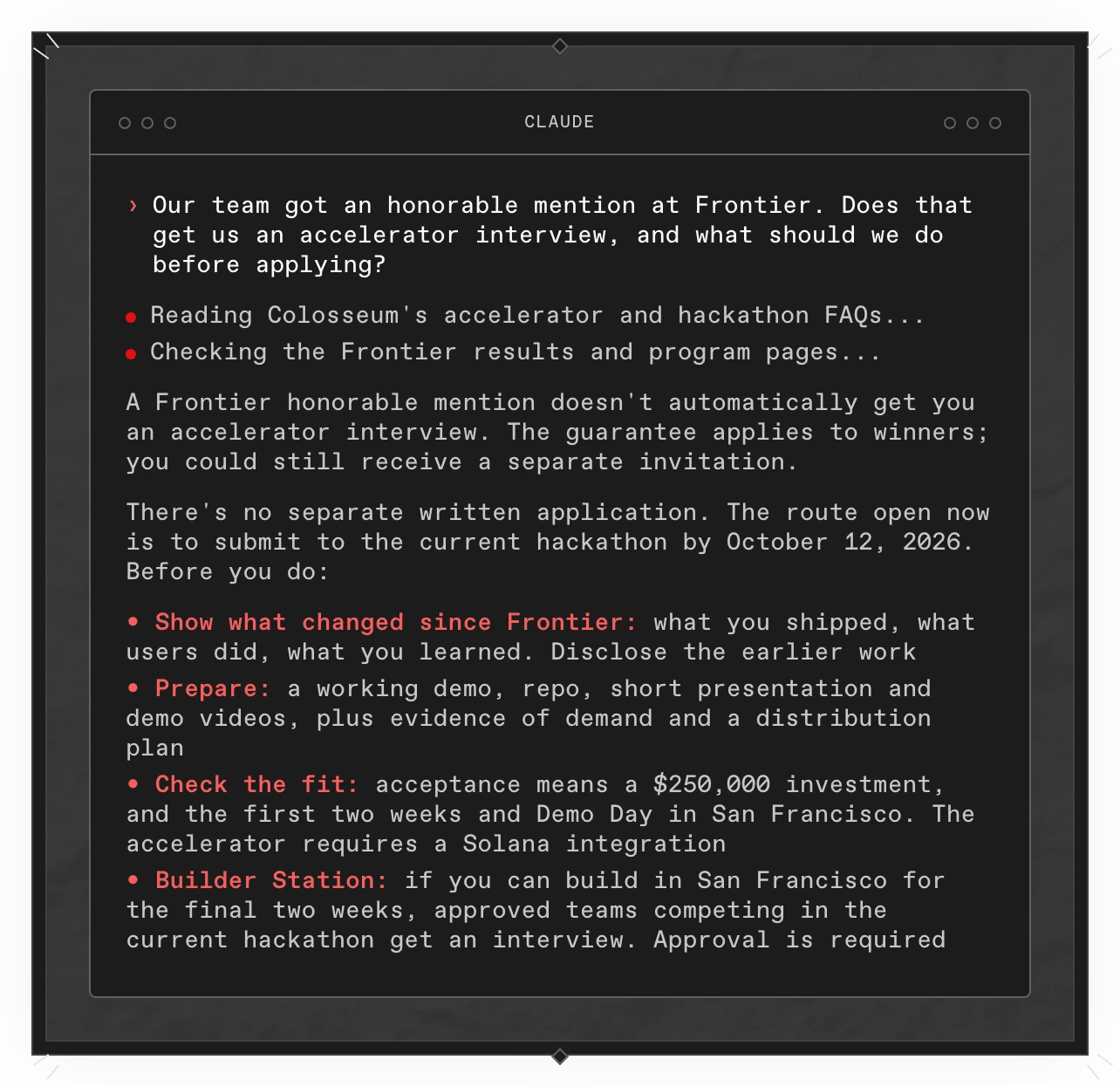
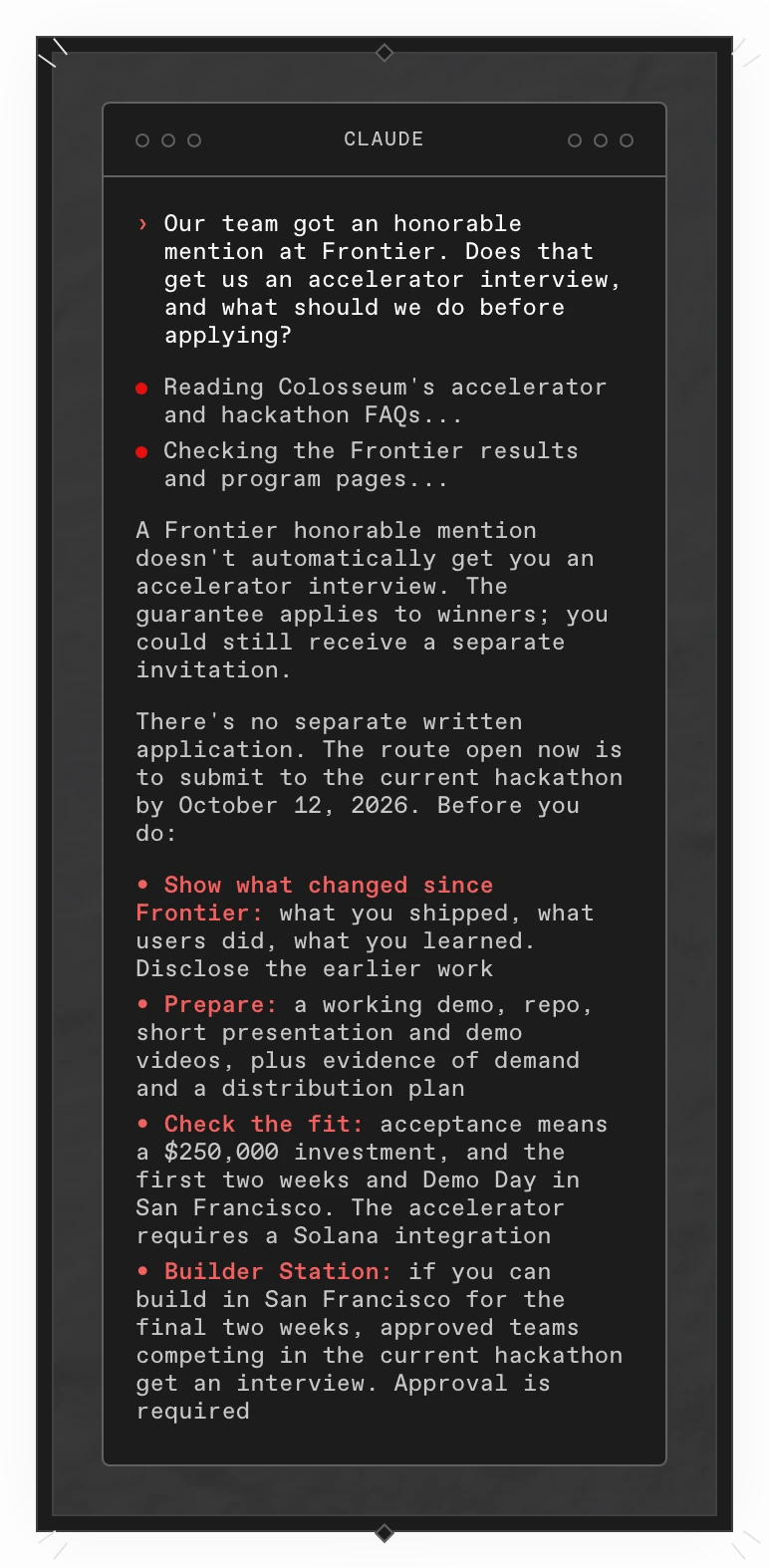
“Our team got an honorable mention at Frontier. Does that get us an accelerator interview, and what should we do before applying?”
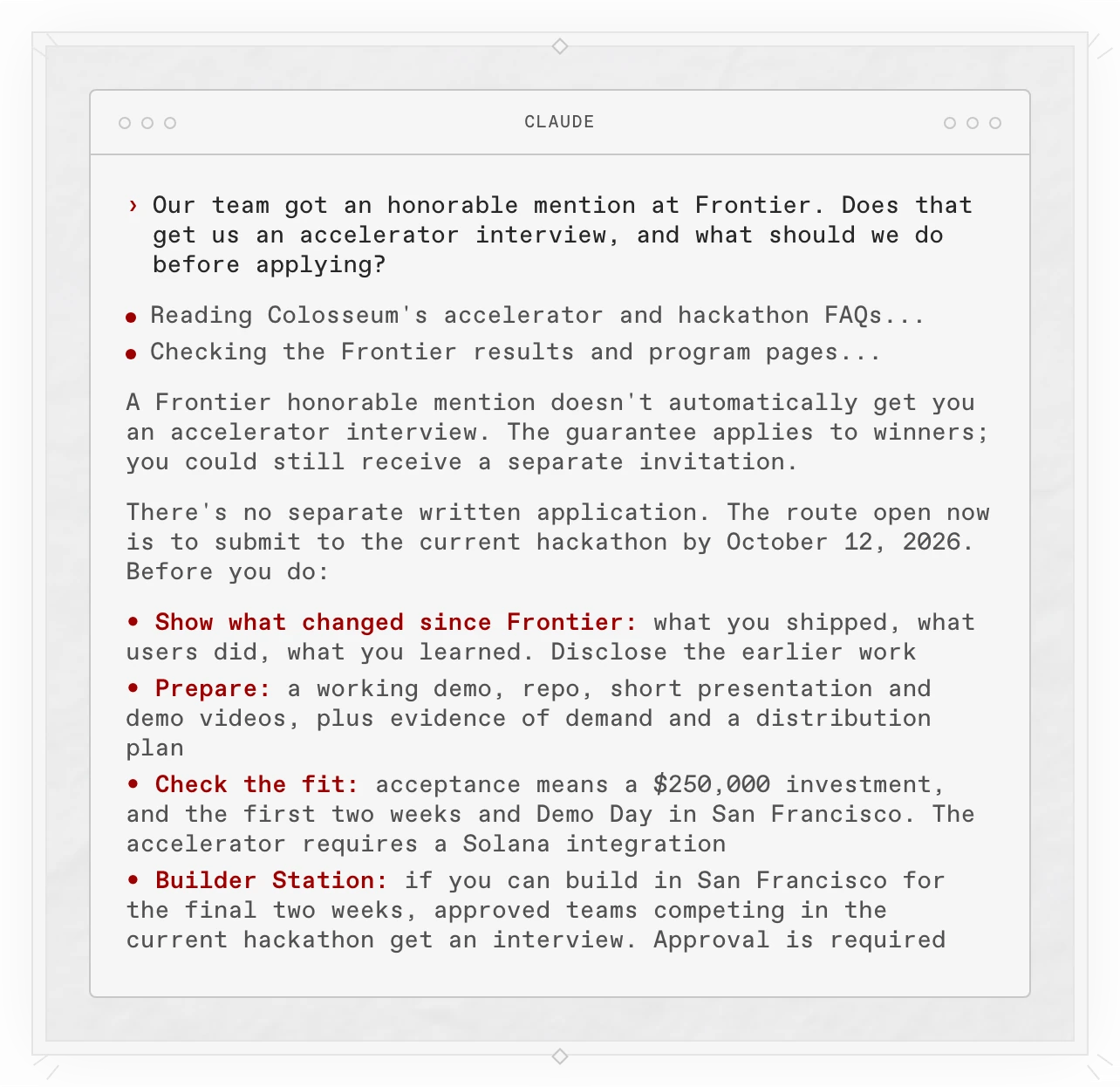
A Copilot answer in a terminal: a Frontier honorable mention doesn't automatically get an accelerator interview. It lists what to prepare before submitting to the current hackathon, the accelerator's terms, and the Builder Station route for approved teams. A Copilot answer in a terminal: a Frontier honorable mention doesn't automatically get an accelerator interview. It lists what to prepare before submitting to the current hackathon, the accelerator's terms, and the Builder Station route for approved teams. A Copilot answer in a terminal: a Frontier honorable mention doesn't automatically get an accelerator interview. It lists what to prepare before submitting to the current hackathon, the accelerator's terms, and the Builder Station route for approved teams. A Copilot answer in a terminal: a Frontier honorable mention doesn't automatically get an accelerator interview. It lists what to prepare before submitting to the current hackathon, the accelerator's terms, and the Builder Station route for approved teams.

Compare hackathons

Copilot puts every project in one main category, such as Events & ticketing or Prediction & information markets. It also records the tools found in each team’s code. Use both to see how a space changed over time.
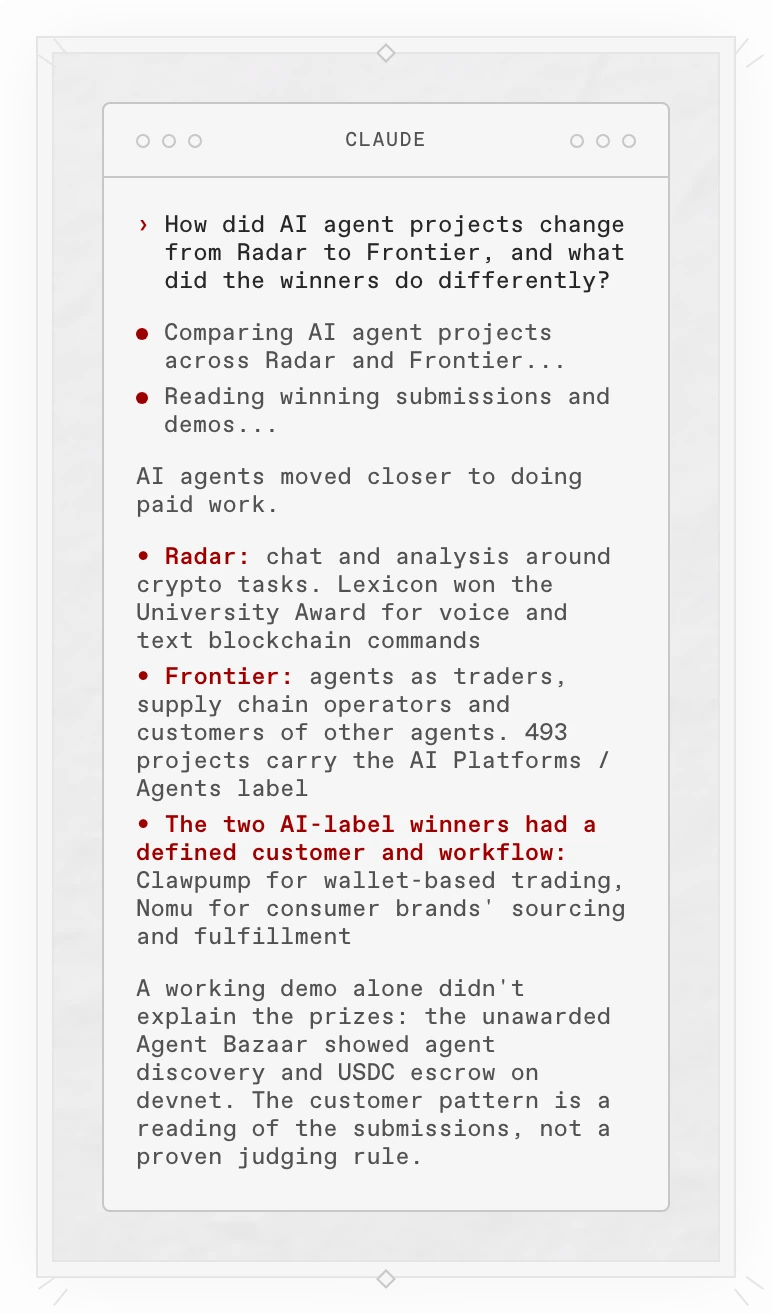
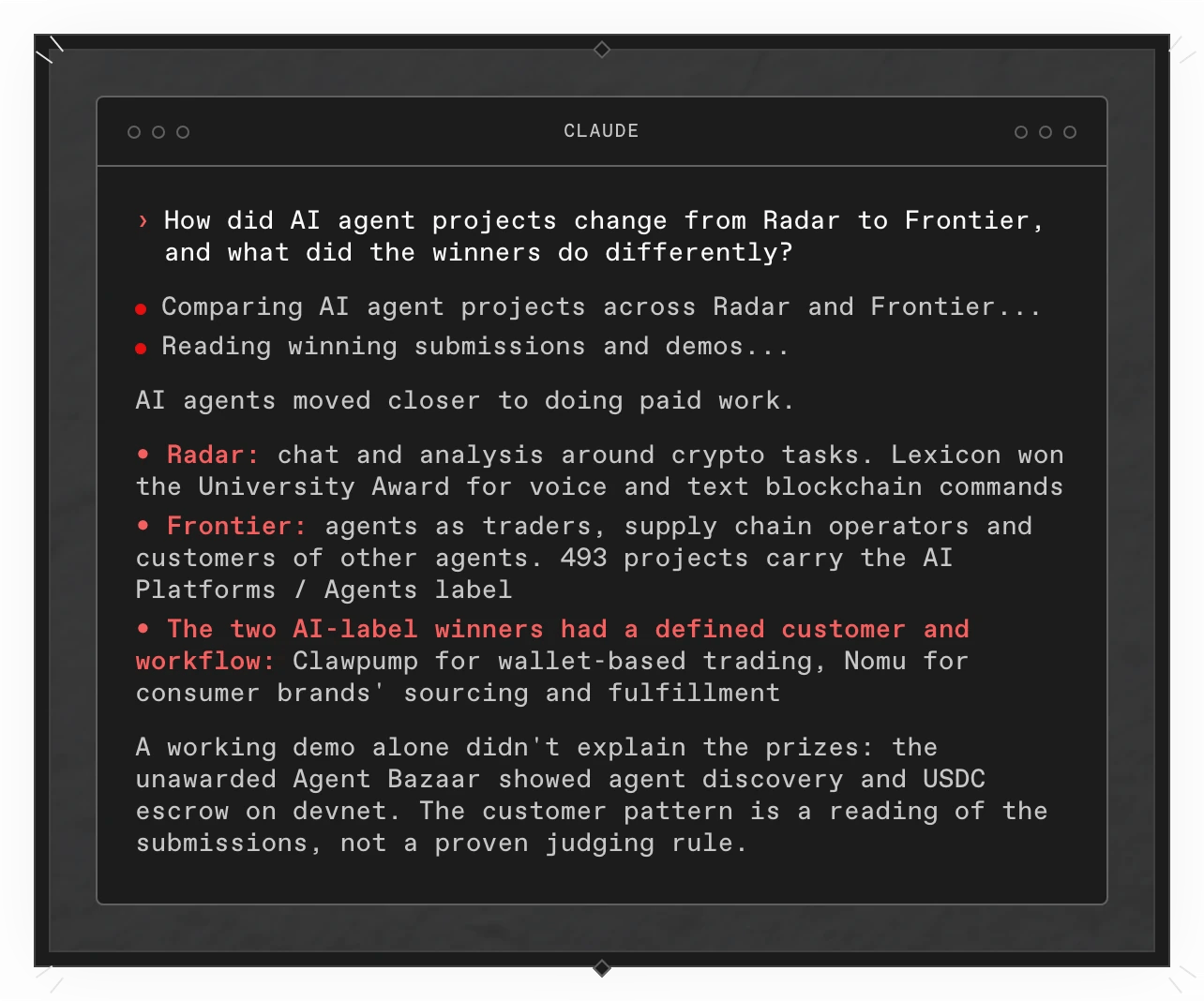
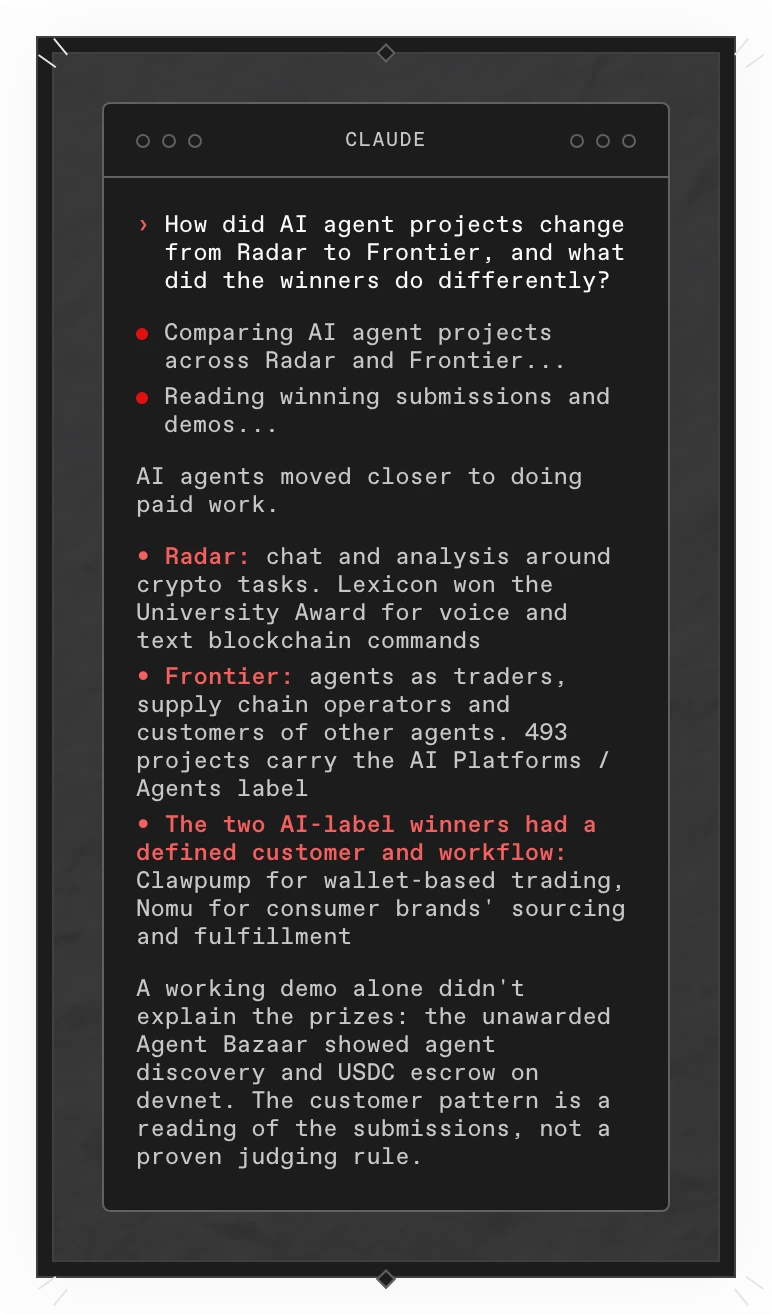
“How did AI agent projects change from Radar to Frontier, and what did the winners do differently?”
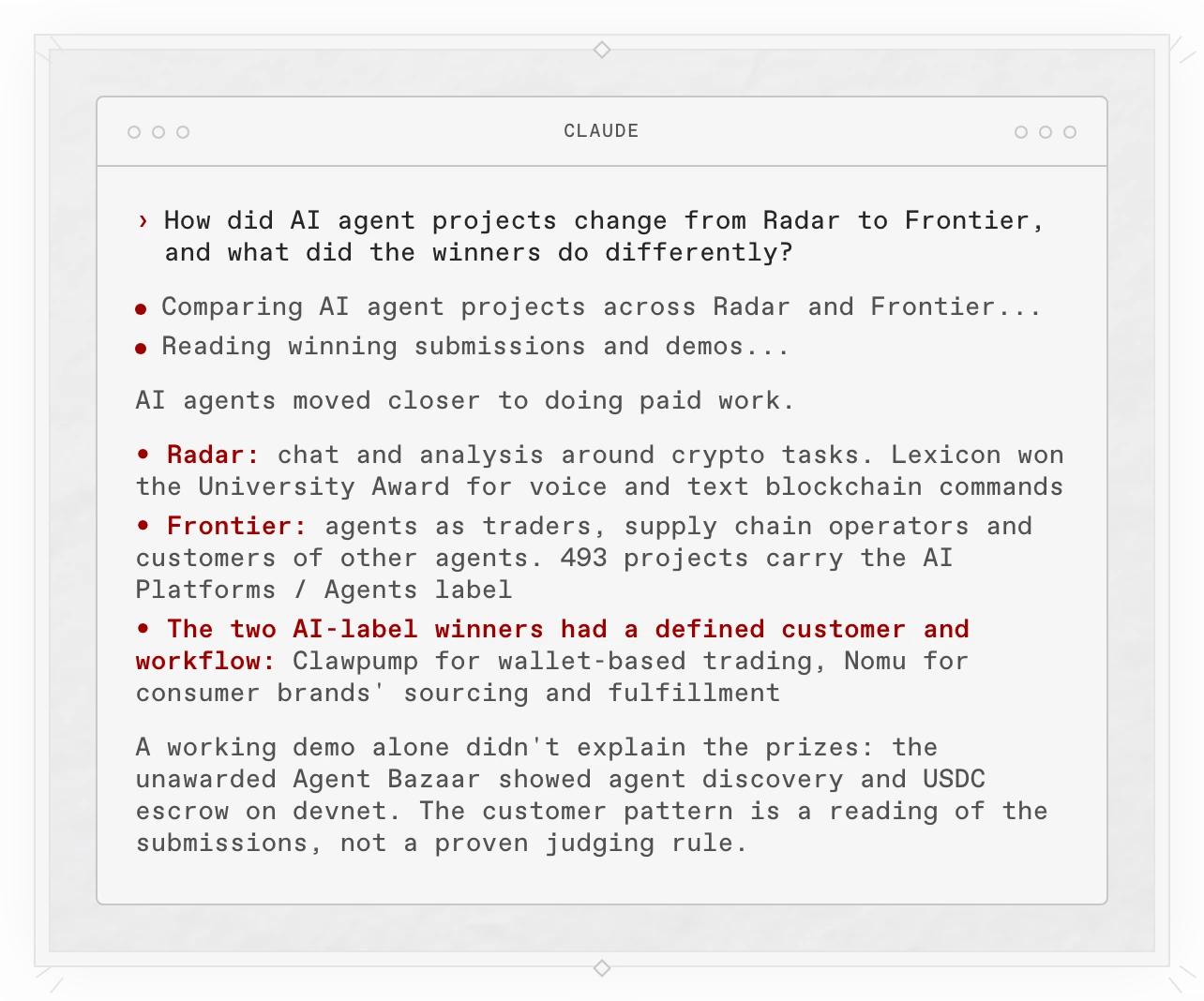
A Copilot answer in a terminal: from Radar to Frontier, AI agents moved closer to doing paid work. The two AI-label winners, Clawpump and Nomu, had a defined customer and workflow, a pattern the answer calls its own reading rather than a judging rule. A Copilot answer in a terminal: from Radar to Frontier, AI agents moved closer to doing paid work. The two AI-label winners, Clawpump and Nomu, had a defined customer and workflow, a pattern the answer calls its own reading rather than a judging rule. A Copilot answer in a terminal: from Radar to Frontier, AI agents moved closer to doing paid work. The two AI-label winners, Clawpump and Nomu, had a defined customer and workflow, a pattern the answer calls its own reading rather than a judging rule. A Copilot answer in a terminal: from Radar to Frontier, AI agents moved closer to doing paid work. The two AI-label winners, Clawpump and Nomu, had a defined customer and workflow, a pattern the answer calls its own reading rather than a judging rule. These counts describe what teams submitted, not market demand.

Trace a startup’s history

Follow a company from its hackathon submission to today, using project records, the research library and current websites.
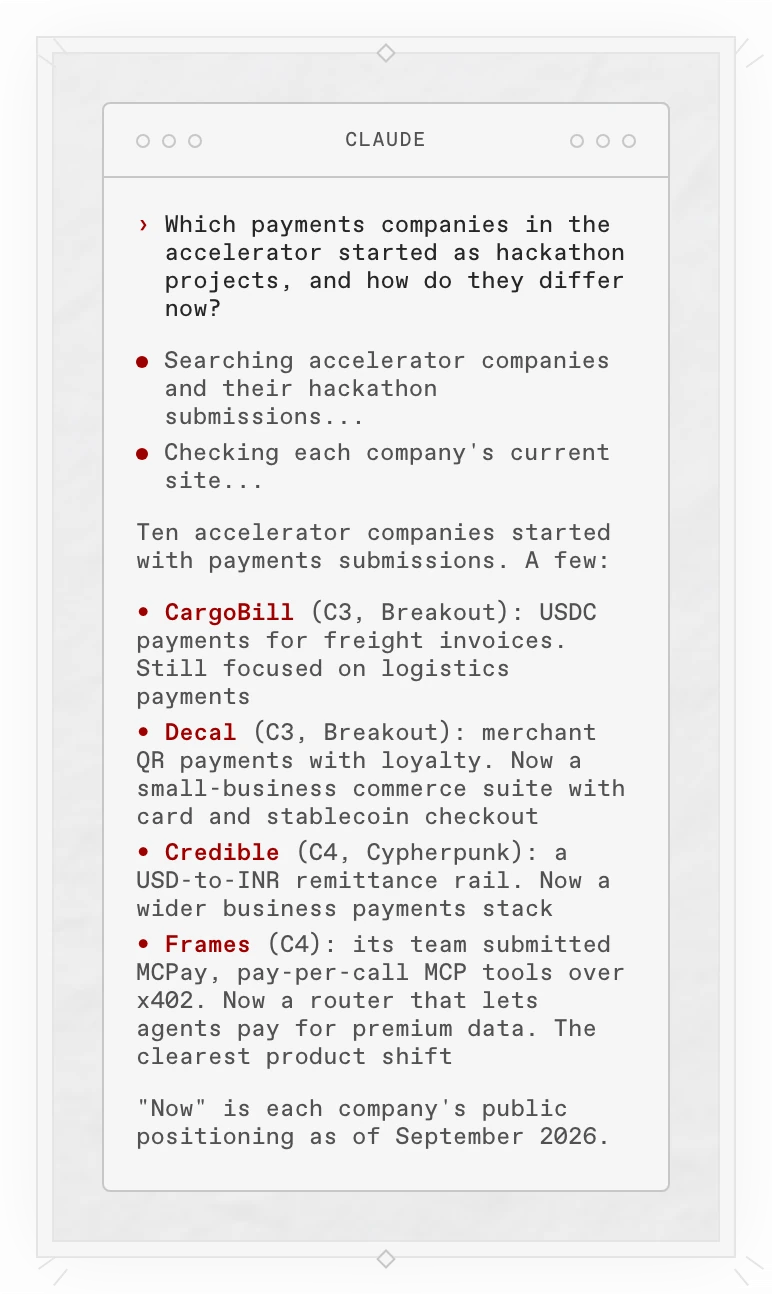
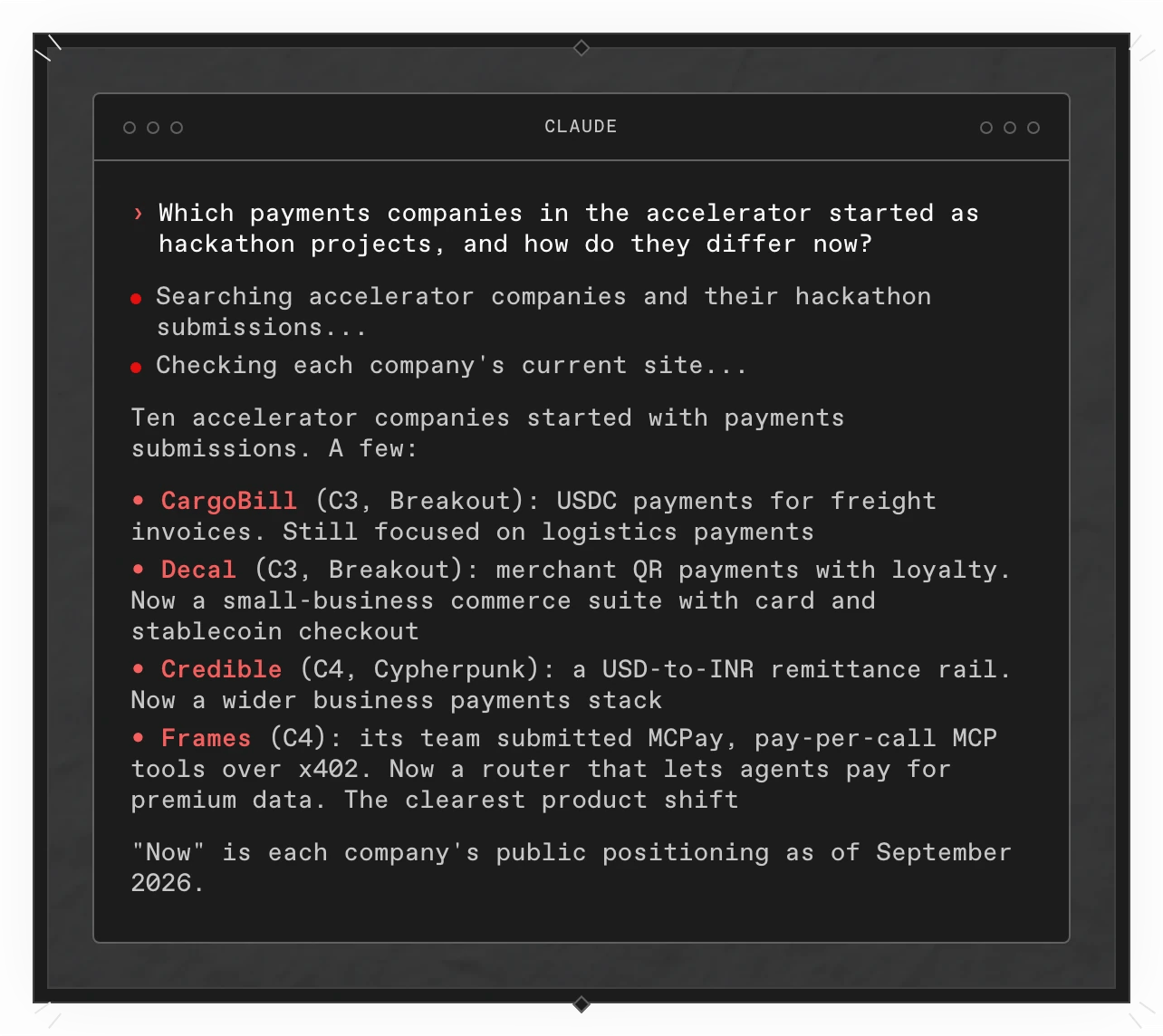
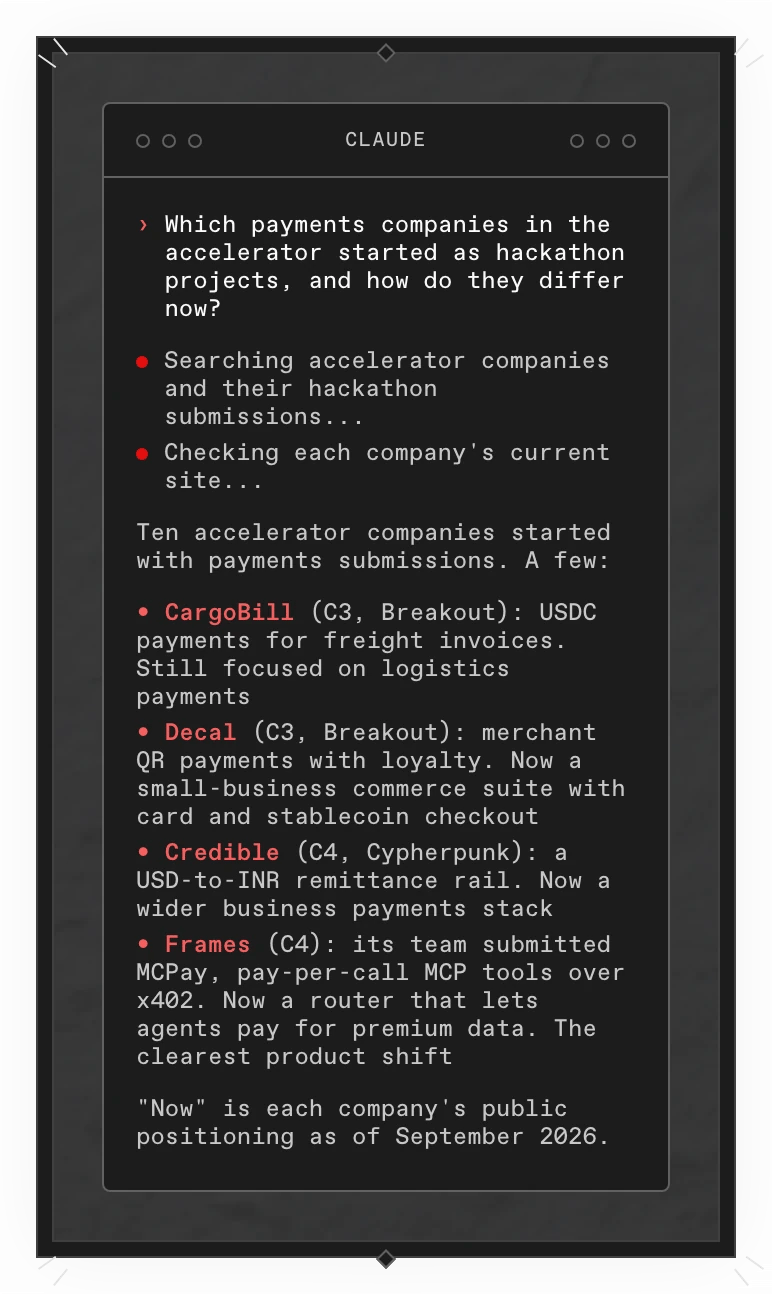
“Which payments companies in the accelerator started as hackathon projects, and how do their products differ today from what they submitted?”
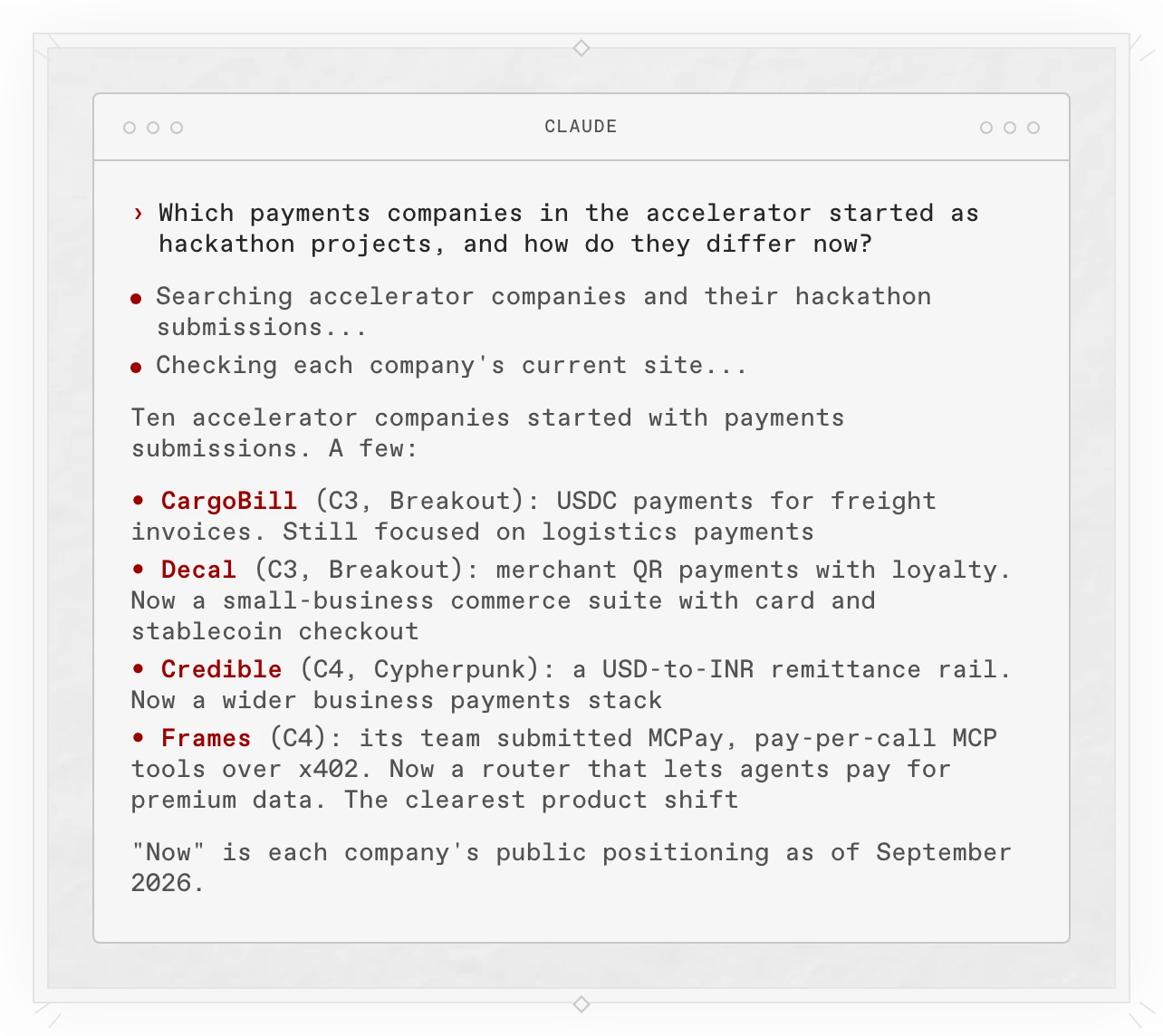
A Copilot answer in a terminal: ten accelerator companies started with payments submissions, including CargoBill, Decal, Credible and Frames, with what each submitted and how it differs now. A Copilot answer in a terminal: ten accelerator companies started with payments submissions, including CargoBill, Decal, Credible and Frames, with what each submitted and how it differs now. A Copilot answer in a terminal: ten accelerator companies started with payments submissions, including CargoBill, Decal, Credible and Frames, with what each submitted and how it differs now. A Copilot answer in a terminal: ten accelerator companies started with payments submissions, including CargoBill, Decal, Credible and Frames, with what each submitted and how it differs now.

How to read an answer

  • Check the link and date beside anything you plan to act on.
  • A project summary describes what a team submitted, not what it runs today. Ask your agent to check the live site.
  • A prize is an award, not proof of users or revenue. An honorable mention is not a prize win.
  • A missing tool doesn’t mean a team never used it. Copilot only records the tools it found in a team’s code.
  • Coverage is deepest on Solana. Fewer results on another chain can mean fewer records, not less activity.
  • For prices, rules, security advice or a company’s current status, ask your agent to open the live page.

Where answers come from

  • Projects: public submissions from Renaissance, Radar, Breakout, Cypherpunk and Frontier. Many include summaries of the team’s code, pitch and demo, each dated to when its source was captured.
  • Research library: Satoshi’s emails and forum posts, the Cryptography Mailing List, research from a16z crypto, Paradigm, Multicoin, Galaxy, Electric Capital and Pantera, Breakpoint talks, Solana’s docs, improvement proposals and core calls, security research from OtterSec, Neodyme and Sec3, and essays from Paul Graham and Sam Altman. Sources update on different schedules. Some publishers’ work appears as a short excerpt with a link to the full piece.
  • Tools: Colosseum’s resources hub for the current hackathon.
  • Colosseum programs: Colosseum’s official FAQs, with links to the live program pages.
  • Today’s landscape: your agent can check The Grid and the web directly.
  • Cypherpunk history: Cryptography Mailing List; Satoshi’s forum posts and emails; Nick Szabo’s essays, blog, and legacy essays; Robin Hanson’s Overcoming Bias; Nakamoto Institute Library; arXiv cryptography and crypto-economics.
  • Solana protocol and community: SIMD documents, discussions, and issues; Solana Developer Forum; core community call notes and transcripts; delegation program; Solana, Agave, and Program Library docs; Solana core, Program Library, and Agave repository issues and pull requests; Solana Stack Exchange; Cookbook; official news.
  • Breakpoint: talk transcripts from 2022, 2023, 2024, and 2025.
  • Protocol docs: Jupiter, Orca, Raydium, Drift, Meteora, Marinade, Tensor, Jito, and Phantom.
  • Infrastructure and governance: Helius blog and RPC docs; Jito research; Firedancer; Triton; Yellowstone gRPC; MagicBlock docs and blog; Squads docs and blog; Realms.
  • Security: Sec3, OtterSec, and Neodyme.
  • Research: Paradigm, a16z Crypto, Multicoin Capital, Pantera Capital, Alliance DAO, Placeholder, Electric Capital, Galaxy Research, Coin Metrics, and Chainalysis.
  • Builder writing: Paul Graham, Sam Altman, Colosseum blog and podcast, and Superteam blog.
To find out whether a particular source is in the library, ask your agent.

Optional: paid research with Frames

Frames logo Frames logo Some questions need current data that free sources don’t cover, such as a startup’s latest funding, market data or social reach. When that would improve an answer, your agent may suggest Frames. Colosseum is an investor in Frames. You don’t need Frames to use Copilot, and it isn’t part of setup. It’s a separate service with its own account and credits. Its free plan includes 1,000 credits a month. Your agent asks before connecting Frames and before anything that costs credits, and tells you the most it could spend. Connecting Frames doesn’t turn on Copilot sharing. To connect it yourself, create a Frames account, then:
Then type /mcp in Claude Code and sign in to Frames.